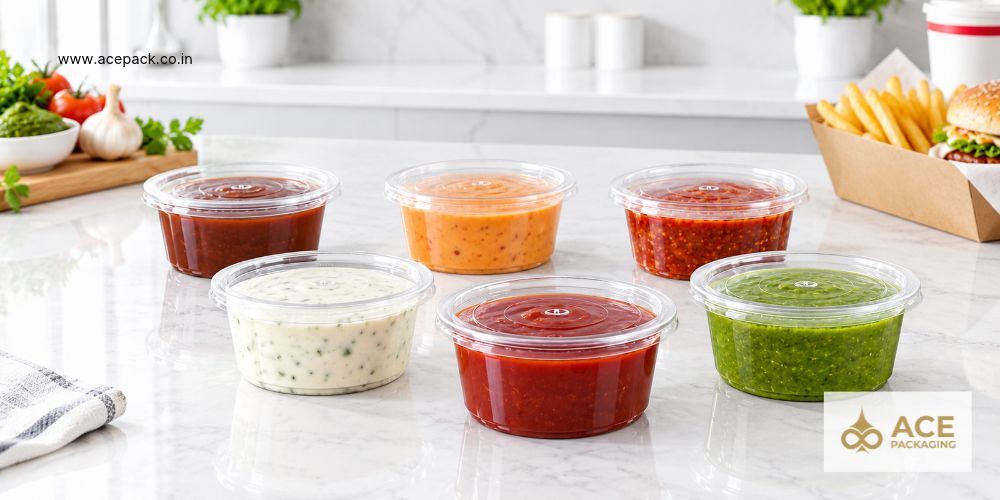
Walk into any QSR kitchen during a lunch rush and watch how sauce gets scooped into a cup. Nobody's measuring. Someone fills it by eye, snaps a lid on, and moves to the next order. Multiply that across a hundred outlets and thousands of daily transactions, and a condiment that was never properly sized becomes one of the quieter cost leaks - or complaint sources - in the whole operation.
This is the gap Portion Cups are meant to close. With sizes stepping from 50ml up to 250ml, the range gives multi-outlet food brands a way to lock in sauce, dip, and chutney quantities once, rather than leaving it to whoever happens to be behind the counter that shift.
Dine-in restaurants can top up a sauce bowl if a guest asks. QSR format doesn't allow for that. Whatever goes into the bag at the point of packing is the final word - there's no second chance to adjust once the order leaves the counter.
That single fact turns portioning into both a financial lever and a brand-experience lever at once. A cup that's consistently a little too generous bleeds sauce cost across every transaction, invisibly, until someone finally runs the monthly numbers and wonders where the margin went. A cup that's consistently stingy does the opposite kind of damage - quieter still, since most customers won't complain, they'll just stop adding that item to future orders. Neither failure announces itself loudly. Both show up eventually in the data.
The Portion Cups lineup isn't arbitrary - each step up in size solves a different packaging problem rather than just offering "more."
50ml fits condiments meant to be used thinly - a splash of ketchup, a dab of mustard, something accompanying a smaller snack item rather than carrying the meal.
100ml is the workhorse size for dipping sauces that need to last through a standard order of fries, wings, or similar shareable sides.
125ml earns its place for richer or thicker condiments - a mayo-based dip or a denser chutney - where expectations sit a notch above the basic dipping-sauce tier.
150ml handles sauces marketed as a bigger part of the order, or a chutney meant to cover a larger combo, where 100ml would run dry halfway through the meal.
250ml steps outside condiment territory into near-side-dish volume - appropriate for bulk dip orders, family combos, or any sauce positioned as a featured add-on rather than an afterthought.
Multi-cuisine chains rarely settle on a single size for everything. The more common pattern is picking two or three tiers - a small one for garnish-level condiments, a mid-size for everyday dips, and a larger option for sauces sold as their own line item - and mapping every menu condiment onto that short list instead of inventing a new size for each new product launch.
Before a chain standardizes a condiment at a particular cup size, a handful of checks save headaches down the line.
For a single restaurant, picking a sauce cup size is a minor decision. For a chain, it's an operations decision. The value isn't really in choosing any particular size - it's in every outlet using the same size for the same item, every time.
Inconsistency between branches creates two separate headaches. Regular customers notice when one location is noticeably more generous than another, and that inconsistency erodes trust in the brand's standards. On the supply side, central purchasing and forecasting get harder when different outlets are quietly working from different size assumptions nobody signed off on. A defined, chain-wide sizing standard removes both problems and makes staff training simpler too - new hires only need to learn a short list of item-to-size pairings instead of using guesswork.
For chains weighing sealed, attached-lid formats against open cups for certain condiments, Ace Packaging's comparison of Hinge Cups vs Portion Cups breaks down when each format makes more sense.
Defaulting to one cup size for the whole menu. Forcing every condiment through a single size means some items look over-poured and others look stingy, because not every sauce or chutney calls for the same volume.
Launching a new menu item without testing its sauce at real order volume. A condiment's cup size often gets picked during a recipe tasting session, not during a busy shift, which is where cost and consistency problems actually surface.
Treating delivery and counter orders the same way. A cup that holds fine for a customer walking it to their table can leak inside a sealed delivery bag if the lid was never tested under that kind of jostling.
Letting each location decide for itself. Without a written sizing standard, portions drift from outlet to outlet - and that drift eventually reaches head office, usually through a complaint or a cost report.
Ace Packaging produces the complete Portion Cups lineup alongside related small-format options like Hinge Cups, so QSR chains can source both open-cup and sealed, hinged-lid condiment formats from one place.
A few reasons multi-outlet food businesses work with Ace Packaging on condiment packaging:
Chains building a system-wide condiment sizing standard can reach out to the Ace Packaging team to work through options across the full Portion Cups range before rolling anything out.
Sauce, dip, and chutney portioning isn't a detail to leave to instinct - it's a decision with real cost and consistency consequences once it's repeated across thousands of daily orders and dozens of outlets. The Portion Cups range, running from 50ml through 250ml, gives QSR chains enough size steps to match cup to condiment without overengineering the menu. The chains that get the most out of it are the ones that pick their sizes deliberately and apply them the same way everywhere.
.webp)