
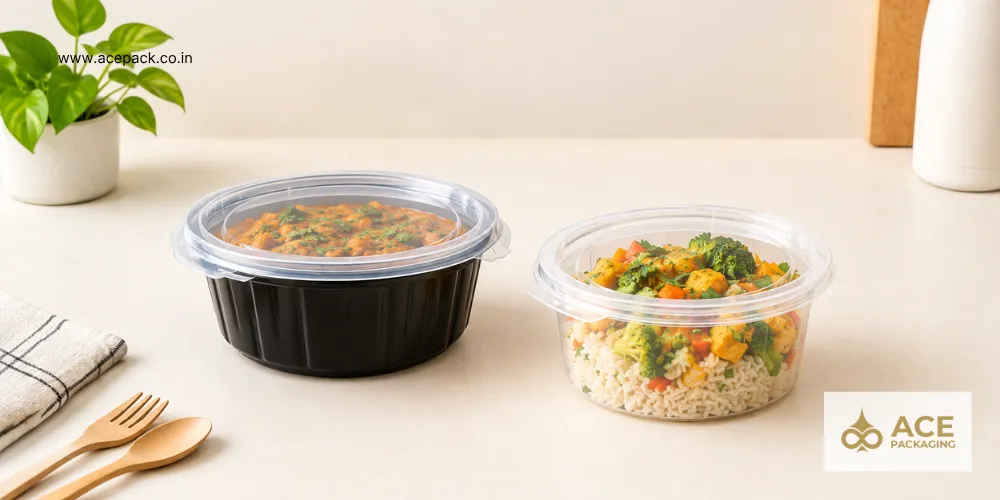
At half past six in the morning, a tiffin kitchen is a small factory. Dal is still steaming, rotis are coming off the tawa, and a packer is already lining up containers for the first delivery run. Nobody is thinking about packaging philosophy. They are thinking about whether the containers on the counter will cover today's plates without a scramble.
That moment is where a packaging choice either helps or hurts a meal subscription business. Natraj Containers are a practical option for kitchens that pack home-style meals in separate portions, because the range offers four sizes that map neatly onto the parts of a plate.
Natraj Containers suit tiffin and meal subscription packing because they come in 250ml, 500g, 500ml, and 750ml sizes, are made from food-grade polypropylene (PP 05), and are supplied in bulk sets of 500 pieces for most sizes. That gives a kitchen enough variety to pack dal, sabzi, rice, and sides separately, without carrying a long list of different containers.
A restaurant packs a wide menu to order. A tiffin or subscription service packs the same few dishes for the same customers, day after day. That repetition changes what a kitchen should look for.
The packaging has to be dependable rather than clever. The same container should handle the same dish every time, so packers build muscle memory and portions look consistent. It also needs to keep dishes apart. Home-style meals mix gravies, dry vegetables, grains, and cooling sides, and sharing one box turns them into a blend nobody ordered.
Subscription customers also judge the whole routine, not a single delivery. A leak on Tuesday, an odd container on Thursday, a missing side on Saturday. Each small slip is noticed, and each one weakens the reason to renew.
Planning is easier when each size has a job. The figures below come from the product pages, and the dish pairings are suggestions to test rather than rules.
All four share a 115mm top diameter, so the footprint is similar across sizes, which can make arranging containers in a bag or carrier simpler. Whether lids fit across sizes is worth confirming with the supplier directly.
A subscription menu rotates, but the plate usually keeps the same structure. A protein or dal, a vegetable, a grain, and a cooling or tangy side. That structure is an opportunity.
Pick one container for each role and stick with it across the week. For example, one size for dal, a second for the vegetable, a third for rice, and a small one for the side. The menu can change daily while the packaging stays the same. Packers learn the pattern quickly, orders look uniform, and stock becomes predictable.
Kitchens that run a few distinct plans, such as a lighter plate and a fuller plate, often need only a fourth size for the larger portions. Resisting the urge to add sizes keeps storage and reordering manageable.
Speed and accuracy matter most in the packing window. A few habits help.
Lay out containers by role before filling begins, so nobody hunts for a size mid-rush. Fill in a fixed order, heaviest and wettest first, so the lighter items do not get disturbed. Close each container as it is filled, rather than batching lids at the end, which reduces spills during handling.
If meals are packed warm, confirm the container's heat tolerance with the supplier for your actual packing temperature. The pages only confirm microwave use for the 500ml size, so it is worth asking about the others before relying on them.
Subscription demand is known in advance, which makes inventory planning one of the easier parts of the job. The risk is complacency.
Natraj Containers ship in sets of 500 pieces for most sizes, and a kitchen serving a few hundred customers with several containers each uses through a box quickly. Set a reorder point for every size based on the busiest week, not the average. Keep a small buffer, so a delayed supplier delivery never forces a substitution mid-week. And store boxes close to the packing area, since a few extra steps each morning become hours over a month.
A subscription customer sees the same plate twenty times a month, so portion drift gets noticed. One day the dal fills the container to the brim, the next day it barely covers the base.
Matching each dish to one container size helps, because the container itself becomes a visual guide. Some kitchens add a simple fill mark in their own prep notes, such as a height from the rim, so packers share the same standard. Weighing a sample portion once a week keeps the standard honest without slowing the line.
Demand swings around festivals, exam seasons, and new customer drives. A kitchen that grows by a third in a fortnight can run through a month of containers in days.
Look ahead and raise the reorder quantity before the surge, not during it. Check storage space too, since bigger orders mean more boxes. And talk to the supplier early about timing, because bulk orders take planning on both sides.
Natraj Containers cover the main portions. The rest of a tiffin often needs different shapes.
Portion Cups handle pickles, chutneys, and sauces in small, measured sizes. Flat Containers suit rotis, parathas, and drier items, where a shallow container keeps food in a tidy layer. Businesses that prefer to pack a whole meal in one rectangular container can look at RE Series Containers.
Choosing for one dish. A container that suits dal may not suit rice. Plan around the full plate.
Skipping a delivery test. Pack real portions and carry them through an actual run before ordering in bulk.
Assuming heat tolerance. Ask the supplier about warm-packed meals instead of guessing.
Adding sizes too quickly. Each size adds a box to store and a reorder to track.
Running stock thin. A missed day costs a subscription business far more than a spare box of containers.
Ace Packaging manufactures Natraj Containers alongside a wider catalogue of food-grade packaging, so a meal subscription business can source main containers, small extras, and flat containers from one place.
A few reasons food businesses work with Ace Packaging.
Manufacturing experience. More than 15 years of producing food-grade containers supports consistent sizing across bulk orders.
Customization options. Specifications can often be adjusted, and the capabilities page is a good place to start.
Certified processes. Products are certified against domestic and global standards, which helps businesses that document their packaging.
Direct order support. The team helps match container sizes and quantities to a real menu and customer count.
Kitchens setting up or scaling a subscription service can contact the Ace Packaging team to discuss sizes, samples, and quantities.
The best tiffin packaging is the kind nobody has to think about. The same few containers, in the same sizes, packed the same way, every morning. Natraj Containers give a kitchen four sizes to build that routine around, with bulk sets that suit steady daily volume. Testing real meals, confirming heat tolerance for warm packing, and reordering against the busiest week keep a subscription running without surprises.
.webp)
