
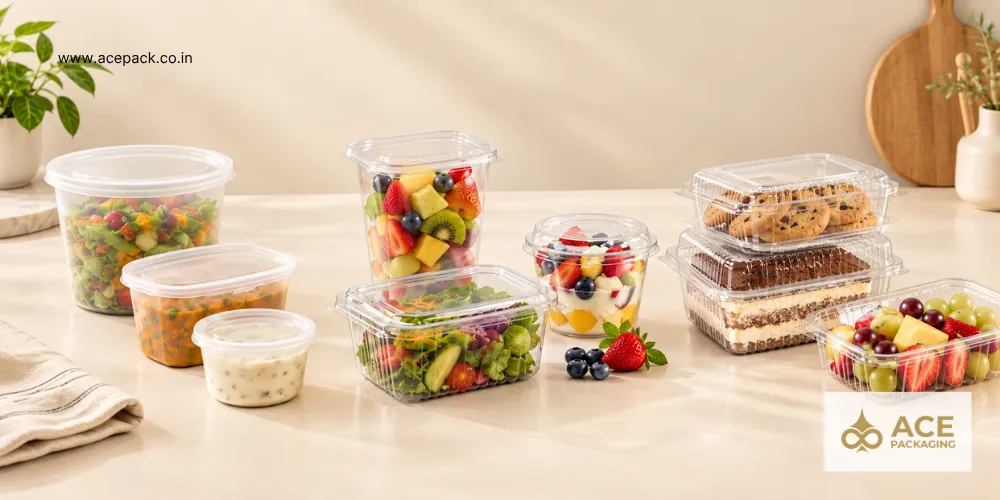
Pick up three food containers from three different suppliers and they can look almost identical while behaving completely differently once food goes inside. One holds up fine in a microwave and cracks in a freezer. Another looks crystal clear on the shelf but turns brittle the moment it's dropped. The material underneath the plastic is doing most of that work, yet it's usually the detail businesses skip past when comparing suppliers.
Three materials dominate food packaging today. Polypropylene (PP), polyethylene terephthalate (PET), and polystyrene (PS) all show up across restaurant supply catalogs, but they aren't interchangeable. Knowing where each one actually performs well makes the difference between a container that quietly does its job and one that causes a complaint three weeks into a bulk order.
Polypropylene (PP) is built for heat. It tolerates microwave use, holds its shape in a freezer, and survives repeated washing in a dishwasher without warping. This is the material most round, deep, or stackable food containers are made from, and it's what Ace Packaging's Round Containers rely on.
PET is the clearest of the three, which makes it a common choice where visibility matters more than heat resistance. It's often used for cold drinks, bakery display boxes, or anything where showing the product through the packaging helps sell it. PET isn't built to handle hot food or microwave reheating the way PP is, so it tends to sit in a different part of a menu than curries or reheated meals.
Polystyrene (PS) is light and inexpensive, which explains why it still shows up in disposable cups, trays, and some takeaway boxes. It's brittle compared to PP and PET, cracks more easily under pressure, and doesn't hold up as well to repeated use or reheating. For businesses prioritizing cost over durability on single-use items, PS still has a place, though it's less common for containers meant to survive storage, stacking, or multiple uses.
Hot or reheated food calls for PP almost every time. Curries, rice dishes, soups, anything that goes through a microwave at some point after packing needs a material that won't warp or leach odors under heat. This is why RO-Series and RE Series containers are built from PP 05, since both ranges are designed around hot food packing.
Cold or chilled items have more flexibility. Dairy products, salads, cold desserts, and drinks can work in PP, PET, or in some cases PS, depending on whether visibility or cost matters more than heat tolerance. Round Containers made from PP cover a lot of this ground already, with some sizes offering a transparent body for shelf visibility without switching materials entirely.
Display-focused packaging often leans toward PET for its clarity, particularly for bakery items, sweets, or anything a customer wants to see before buying.
Single-use, low-cost packaging is where PS still competes, mainly for disposable cups or trays where the container isn't expected to survive reheating, freezing, or repeated handling.
A restaurant, caterer, or cloud kitchen rarely deals with just one food category. The same kitchen that packs cold salads at lunch might reheat a curry for dinner delivery, and that kind of range is exactly where PP earns its reputation as the default choice across food service.
Round Containers are a practical example of this. Built from food-grade PP 05, the range spans from 225ML up to 1000ML, with some sizes offering a transparent body so visibility isn't entirely sacrificed for heat tolerance. The same container that holds curd or yogurt safely in the fridge can go into a microwave later without the material degrading, which isn't something PET or PS can promise with the same confidence.
This versatility is also why PP shows up across most of Ace Packaging's catalog, not just Round Containers. RO-Series, RE Series, Flat Containers, and ZEN Series are all built on the same material logic, since it lets a business standardize on one plastic type across a varied menu rather than juggling different materials for different dishes.
Will the food be reheated after packing. If yes, PP is close to a requirement rather than a preference, since PET and PS aren't built for repeated microwave use.
Does the product need to be visible on a shelf or in a display case. PET's clarity is hard to match if that's the priority, though some PP options now offer transparent variants that narrow the gap.
How many times will the container realistically be handled. PS tends to show its limits fastest under repeated handling, stacking, or transport, while PP holds up better across a longer packaging and storage cycle.
What's the cost tolerance per unit at scale. PS remains the cheapest option for simple, single-use needs, but that saving can disappear quickly if breakage or customer complaints increase as a result.
Does the business need one material across multiple product types. Standardizing on PP across a catalog, the way Ace Packaging does with Round Containers, RO-Series, and RE Series, simplifies sourcing and reduces the risk of mismatched materials across a kitchen's packaging.
Picking based on price alone. PS might look cheaper per unit, but if it leads to more breakage or can't handle reheating, the real cost shows up later in waste and complaints rather than the initial invoice.
Assuming all plastic containers handle microwave use the same way. Only PP is reliably built for this. Using PET or PS for hot, reheated food risks warping or an unpleasant smell transferring into the food.
Overlooking material consistency across a menu. Mixing PP, PET, and PS across different dishes can complicate packing lines and storage, since staff need to track which container goes with which food type rather than following one simple rule.
Not checking for food-grade certification. Not every plastic labeled for general use meets food-contact safety standards, so it's worth confirming food-grade certification regardless of which material is chosen.
Ace Packaging manufactures its full container range, including Round Containers, RO-Series, RE Series, and Flat Containers, from food-grade polypropylene (PP 05), giving businesses a consistent material choice across a varied menu rather than switching materials product by product.
A few reasons food businesses rely on Ace Packaging when choosing container material.
Manufacturing experience. Years of producing food-grade PP containers at scale has built reliable quality across sizes and ranges.
Certified processes. Products are certified against domestic and global standards, useful for businesses documenting their packaging sourcing.
Customization support. Specifications can often be adjusted for specific business needs. Worth checking through the capabilities page.
Direct order support. The team works with clients to match material and container type to the actual food being packed, rather than defaulting to whatever is cheapest to produce.
Businesses weighing material options for a new or existing product line can contact the Ace Packaging team to talk through what fits their menu best.
Material choice isn't a background detail in food packaging. It decides whether a container survives a microwave, holds its shape in a freezer, or cracks after a single reheating cycle. PP tends to be the most versatile option for food businesses handling a mix of hot, cold, and reheated items, which is why it underpins ranges like Round Containers. Matching material to the actual food and handling conditions, rather than defaulting to whatever's cheapest, remains the most reliable way to avoid problems after a bulk order is already in use.
.webp)


