
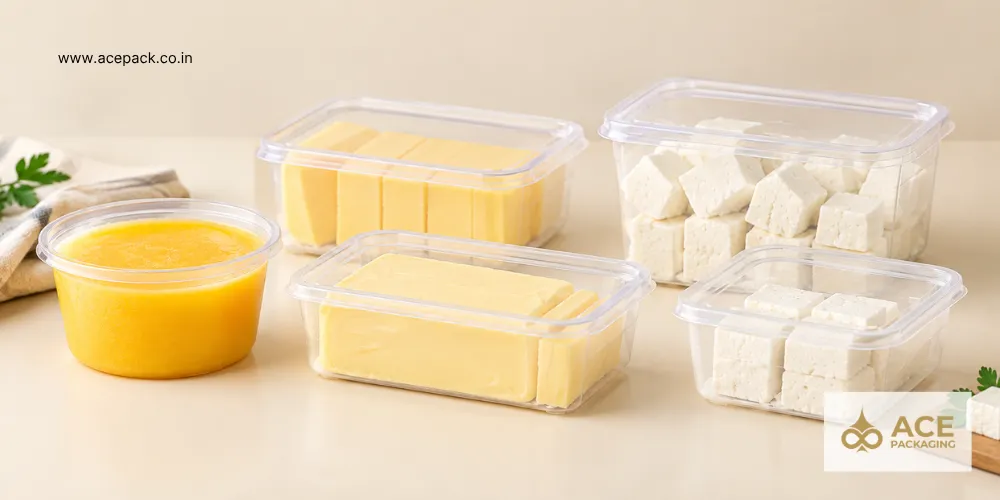
A dairy business can make excellent ghee and still lose repeat customers over the jar it arrives in. A lid that loosens in transit, a butter tub that sweats in the fridge, a paneer pack that fills with liquid by day two. None of these are product problems, but customers experience them as product problems, and they rarely stop to separate the two.
Ghee, butter, and paneer look like neighbours in a dairy range, yet they ask very different things from a container. One is a fat that changes texture with temperature. One is a soft spread that picks up smells. One is a moist, perishable block that needs to stay cold and contained. Choosing a single container for all three usually means at least one of them is poorly served.
Ghee is mostly about sealing and handling. It gets scooped, poured, carried home, and opened repeatedly over weeks, so the container needs a lid that closes properly every time and walls that hold their shape when gripped. Because ghee is often filled while warm and then cooled, a business should confirm with its supplier how the container behaves at its actual filling temperature rather than assuming.
Butter is sensitive to temperature swings and to odours. A container that sits loosely under its lid lets air in, and air is what dulls butter's flavour over time. Butter also needs to be scooped or cut cleanly, which makes the interior shape of the tub matter more than people expect.
Paneer brings moisture into the equation. Fresh paneer releases liquid, so the container has to hold the block without leaking in the fridge or in a delivery bag, and it has to stack neatly in cold storage where space is always tight.
Across all three products, the same handful of requirements keep coming up.
Round Containers suit this kind of range well, mainly because of how the shape behaves. With no corners, the lid presses evenly around the rim, and there are no tight angles where butter or ghee gets trapped. The range is made from food-grade polypropylene (PP 05), comes in sizes from 225ML to 1000ML, and is built to be microwave, freezer, and dishwasher safe. Smaller sizes are supplied in sets of 500 pieces per box, which suits dairies packing at volume.
Some sizes also come with a transparent body, which lets a customer see the contents without opening the lid. For a retail dairy counter, that visibility does a quiet amount of selling, since people can judge the colour and texture of ghee or butter before they buy.
For a deeper look at how the round shape handles dairy, spreads, and prepared foods more broadly, Ace Packaging has a separate guide on Round Containers for dairy products, spreads, and prepared foods that this article builds on from the business side.
Size decisions in dairy are often driven by what customers expect to buy, so it helps to think in terms of typical purchase quantities rather than container catalogues.
The smaller Round Container sizes work for sample portions, single-serve butter, or small ghee pots sold as gifts or trial packs. Mid-range sizes suit everyday retail packs of ghee or butter. The 1000ML size suits larger household ghee packs and paneer sold in bulk to restaurants or caterers.
For businesses that also sell to households through a wider catalogue, Natraj Containers offer a different set of sizes, including 250ml, 500g, 500ml, and 750ml options, and are worth comparing if a dairy range needs a gram-based pack size.
A dairy business selling across a counter has different priorities from one supplying restaurants and sweet shops.
Retail packaging has to look right and survive a customer's journey home. Visibility, a clean closing lid, and a size that matches how households actually buy all matter here. Wholesale packaging is more about consistency and handling. Containers need to stack on pallets, survive a delivery run, and arrive in quantities that fit the buyer's storage, which is where bulk box quantities become a real planning factor.
Many dairies run both channels at once. In that case it often makes sense to standardise on one container family, using smaller sizes for retail and larger ones for wholesale, so sourcing and storage stay simple.
Using one container for ghee, butter, and paneer. The three behave differently, and a container that works for ghee may not hold paneer's moisture or suit a butter scoop.
Skipping a real-world test. A container that looks fine empty can behave differently after a night in a fridge or a trip in a delivery bag. Test with the actual product before ordering in bulk.
Ignoring filling temperature. If ghee goes into the container warm, confirm the container's heat tolerance with the supplier. Assuming it will be fine is how warped jars end up on shelves.
Ordering without planning storage. Bulk boxes take up real space. A 500-piece box of containers needs a dry, clean spot well before the first production run.
Treating the lid as an afterthought. For dairy, the lid is the part customers touch most. A weak lid costs more in complaints than it saves in unit price.
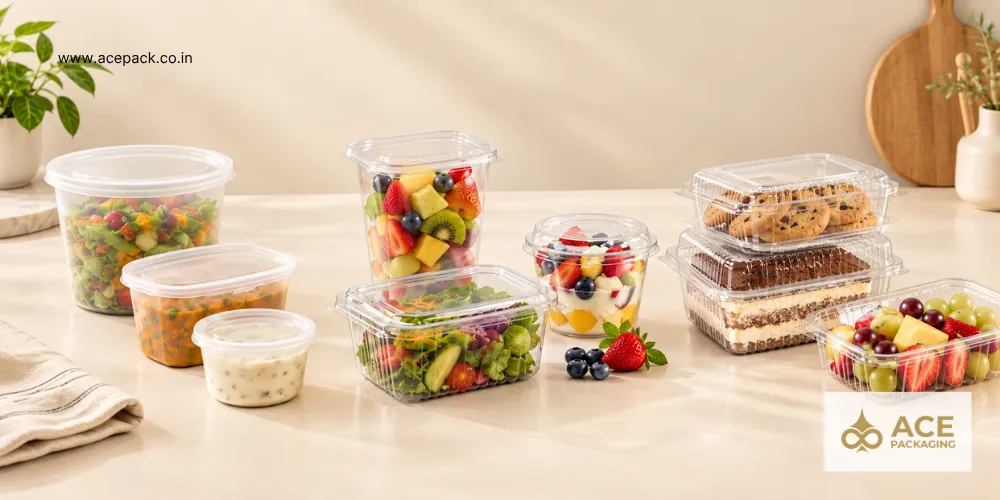
Ace Packaging manufactures Round Containers alongside a wider catalogue of food-grade packaging, including Deli Series Containers for prepared and takeaway foods, so a dairy business can source different formats from one supplier.
A few reasons dairy and food businesses work with Ace Packaging.
Manufacturing experience. More than 15 years of producing food-grade containers at scale supports consistent quality across large orders.
Customization options. Specifications can often be adjusted for particular needs, and the capabilities page is the place to start before finalizing an order.
Certified processes. Products are certified against domestic and global standards, which helps dairies that need to document their packaging sourcing.
Direct order support. The team works with clients to match container type, size, and quantity to the actual product being packed.
Dairy businesses planning a packaging change can contact the Ace Packaging team to discuss sizes, samples, and bulk quantities before committing.
Ghee, butter, and paneer share a fridge shelf, but not a packaging brief. Each one rewards a container chosen for how that product actually behaves, from sealing and scooping to moisture and cold storage. Round Containers cover a lot of that ground with an even-sealing shape, food-grade PP 05, and a size range that stretches from small retail packs to larger wholesale ones. Testing with the real product, at the real filling temperature, before a bulk order is still the safest way to avoid problems that only appear once customers are already holding the jar.
.webp)


