
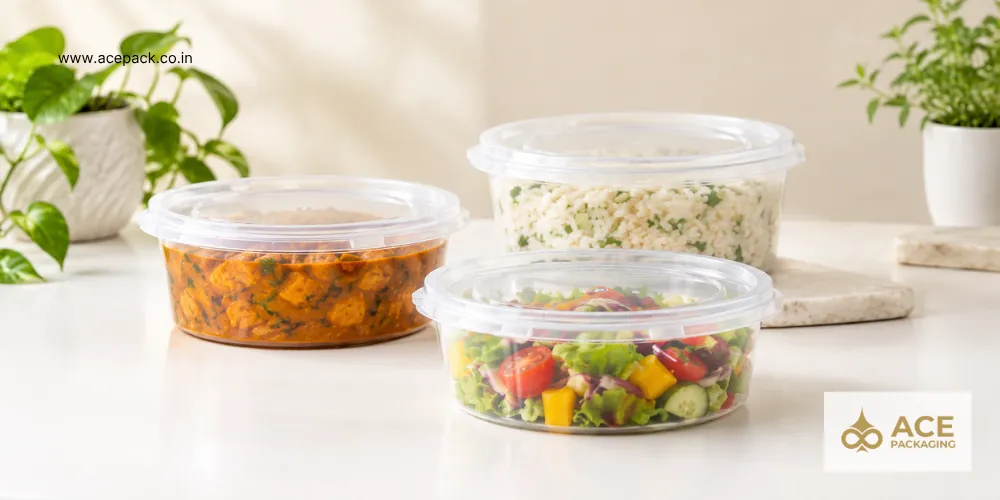
Open the stockroom of any busy kitchen and you can read its packaging decisions in the stacks. Some towers stand straight to the ceiling. Others lean, get restacked every morning, or sit half-empty because nobody trusts them to hold. The containers inside may be equally good. The difference is design, and it quietly decides how much floor, shelf, and cargo space each order consumes.
For a business buying in bulk, that space is a real cost. It is paid in rent for dry storage, in chiller capacity, and in freight, and it rarely shows up next to the unit price. RO-Series Containers are a useful case to study, because their round, stackable design and clear bulk set sizes make the space question easy to work through.
Stackable design saves money by letting a business hold and move more portions in the same space. RO-Series Containers are round, food-grade, and built to stack, with sizes that run from compact portions up to 1590ML and bulk sets of 150 to 300 pieces. A steady stack uses shelf height fully, and clear carton quantities let a buyer plan storage and shipping before ordering. The exact saving depends on the size chosen and the shipment, so the sensible step is to ask for carton details rather than rely on a general claim.
Stacking pays off at two points in a container's life.
Before filling. Empty containers arrive in cartons and wait in dry storage. A container that stacks neatly and ships in a predictable carton makes that space easier to plan. A business ordering several sizes needs a spot for each carton, so the footprint of every size counts.
After filling. Filled containers sit in chillers, freezers, and holding racks where shelf height is fixed and space is costly to run. A stable container lets staff build stacks to the full height of a shelf. An unstable one leaves gaps, and gaps in cold storage are the most expensive empty space in a kitchen.
Round containers have a natural advantage here. With no corners, weight spreads evenly around the rim and base, so a stack tends to sit straight instead of twisting at one edge.
Freight is usually priced by the space a shipment takes up, by its weight, or by whichever is higher. Food containers are light, so many orders are limited by volume. That makes carton size and packing efficiency matter.
Design can influence this in a few ways. A consistent shape across sizes helps cartons pack without wasted room. A bulk set size that matches real usage avoids shipping units that will only sit in a warehouse. And knowing carton dimensions ahead of time lets a buyer estimate pallet or container space instead of discovering it at the quote stage.
RO-Series dimensions show a wider top than base, for example the AP-RO-32 at 185mm across the top and 136mm at the base. Whether empty containers nest into each other, and how that affects carton size, is something to confirm with the supplier before assuming a freight benefit.
The range gives a buyer plenty of steps to choose from, and the set quantities differ in a way that affects planning.
All are made from food-grade polypropylene (PP 05) and are built to withstand microwave, freezer, and dishwasher use. Smaller sizes ship in larger sets, so a business using both ends of the range will store cartons of different counts. More detail on the full lineup is on the RO-Series Containers page.
For a closer look at storage use in particular, Ace Packaging has a related post on storing products efficiently with RO-Series Containers.
Most kitchens do not order a single size. A caterer might use a mid-size container for mains and a compact one for sides, which means two cartons with different piece counts arriving together.
A simple way to plan is to list every size on the menu, note the set quantity for each, and map where each carton will sit before the order lands. Put the fastest-moving size closest to the packing area. Leave room for the next delivery, so new cartons never end up blocking the aisle. A few minutes of planning here prevents the slow, costly habit of storing stock wherever it fits.
A few questions turn an interest in stackability into a decision based on facts.
Round containers are not always the most space-efficient choice. For drier foods, bakery items, and portioned meals, a wide, low profile can stack more compactly, and Flat Containers are built that way. For businesses that prefer rectangular shapes, RE Series Containers are worth comparing. Many kitchens use one round and one flat or rectangular range, matching shape to dish instead of forcing a single container across the menu.
Comparing on unit price only. A cheaper container that packs awkwardly can cost more once space is counted.
Testing only empty stacks. Full containers put real weight on the base and the lid.
Overlooking set size. A set of 300 and a set of 150 take up different room and lead to different reorder rhythms.
Ordering too many sizes. Variety multiplies cartons, and storage rarely grows to match.
Skipping the carton conversation. Carton details are easy to ask for and hard to guess later.
Ace Packaging manufactures RO-Series Containers alongside a wider catalogue of food-grade packaging, so a business can match shape to menu and buy from one supplier.
A few reasons food businesses work with Ace Packaging on bulk orders.
Manufacturing experience. More than 15 years of producing food-grade containers supports consistent sizing across large runs.
Export experience. A client base that includes the UAE, Europe, and Canada means the team is used to orders that travel.
Customization options. Specifications can often be adjusted, and the capabilities page is a good starting point.
Direct order support. The team can share sizing and carton details so a buyer can plan storage before committing.
Businesses planning a bulk or export order can contact the Ace Packaging team to ask for carton dimensions and discuss quantities.
The cost of a container includes the space it takes up, in the stockroom, the chiller, and the cargo hold. RO-Series Containers give buyers a round, stackable design, a wide range of sizes, and clear bulk set quantities to plan around. Asking for carton details and testing filled stacks before a large order is the most dependable way to learn what a container will really cost to store and ship.
.webp)

