
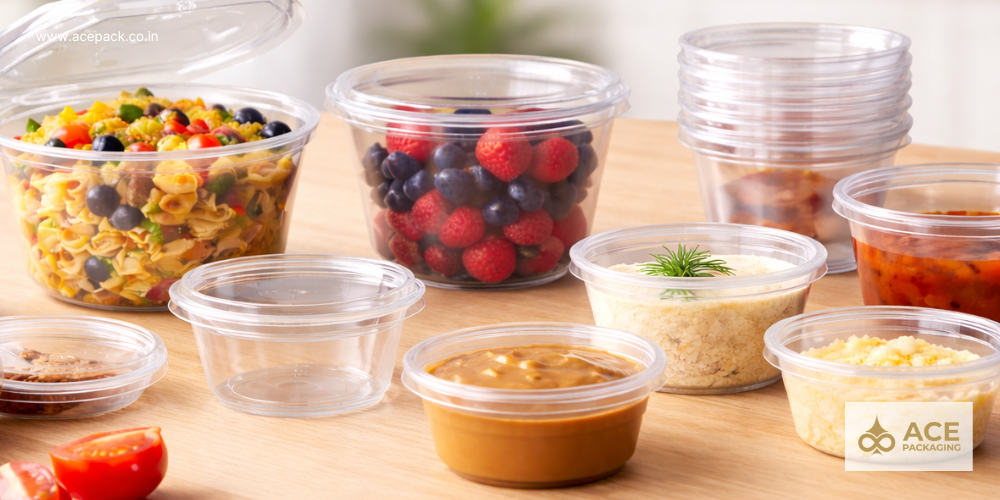
In the food service industry, packaging decisions directly affect speed, hygiene, cost control, and customer satisfaction. Two commonly used packaging options for sauces, sides, and small food portions are Hinge Cups and Portion Cups. Although they may look similar, they serve different purposes and suit different types of food businesses.
Understanding the difference helps restaurants, cafes, cloud kitchens, and food vendors choose the right solution, something packaging manufacturers like Ace Pack consider carefully while designing food-grade containers.
Hinge cups are small containers with a lid that is permanently attached to the cup. The lid opens and closes easily without separating from the container, making them quick and convenient to use.
They are commonly used for sauces, dips, chutneys, dressings, and food samples, especially in takeaway and delivery services.
One of the biggest advantages of hinge cups is speed. Since the lid is attached, staff do not need to handle separate lids, which saves time during busy service hours. This makes hinge cups ideal for quick-service restaurants and high-volume kitchens.
Hinge cups also help maintain better hygiene. Fewer handling steps reduce the chances of contamination, which is important for food delivery and takeaway packaging.
Another key benefit is spill resistance. The secure hinged lid helps prevent leaks during transport, ensuring sauces and liquids reach customers safely. Packaging solutions from companies like Ace Pack are designed keeping these practical needs in mind.
Portion cups are designed to hold measured quantities of food. They usually come with a separate lid and are available in different sizes to suit various serving requirements.
These cups are widely used for portioned sauces, toppings, sides, and ingredients where quantity control is important.
Portion cups help maintain consistency. Serving the same quantity every time ensures customers receive a uniform experience, which builds trust especially for cafés, cloud kitchens, and franchises.
They also support cost control. By using fixed-size portion cups, businesses can reduce over-serving and manage ingredient usage more efficiently. Over time, this helps lower food wastage and improve profitability.
Portion cups are easy to stack and store, making them convenient for preparation areas and bulk food handling. Manufacturers such as Ace Pack offer portion cups in multiple sizes to support these operational needs.
Although both are used for small food servings, their design and function differ.
Lid Design:
Hinge cups have an attached lid for quick sealing, while portion cups use a separate lid for flexibility.
Primary Purpose:
Hinge cups focus on convenience, speed, and spill prevention. Portion cups focus on accurate portioning and consistency.
Operational Impact:
Hinge cups improve packing speed in busy kitchens. Portion cups help control food costs and standardize servings.
Usage Style:
Hinge cups are chosen for ease of use, while portion cups are chosen for precision.
The right choice depends on how your business operates.
Many food businesses use both hinge cups and portion cups together. For example, hinge cups may be used for dips and chutneys, while portion cups are used for measured add-ons or premium ingredients.
This combined approach improves efficiency while maintaining portion control. Packaging ranges offered by Ace Pack are often designed to support this flexibility across different food service needs.
Hinge cups and portion cups are designed for different purposes, and neither is universally better. Hinge cups offer convenience, speed, and secure sealing, while portion cups provide accuracy, consistency, and better control over serving sizes.
The best choice depends on your menu, service style, and daily operations. Selecting the right packaging whether hinge cups, portion cups, or a combination of both helps improve workflow, reduce waste, and deliver a better experience to customers.
.webp)


